If you are serious about email privacy, Gmail and Outlook are not your friends. Both platforms scan metadata, build advertising profiles, and store your messages on servers you have zero control over. On Ubuntu 26.04 LTS, you already made a smart OS choice. Now it is time to make a smart email choice too.
This guide walks you through exactly how to install Proton Mail on Ubuntu 26.04 LTS using three different methods: the native .deb package (recommended), the Snap package, and Proton Mail Bridge for Thunderbird integration. Each step includes the exact terminal commands you need, plus a clear explanation of what each command does and why you cannot skip it. By the end, you will have a working, secure Proton Mail setup running on Ubuntu 26.04 “Resolute Raccoon.”
What You Need Before You Start
Do not skip this section. Missing even one of these prerequisites is the number one reason installations fail halfway through.
System requirements:
- Ubuntu 26.04 LTS (Resolute Raccoon) installed and booted
- A Proton Mail account (free account works for the desktop app with a 14-day trial)
- A user account with sudo privileges (not root)
- Active internet connection
- At least 500 MB of free disk space
Tools you need available:
- wget or curl (for downloading the installer)
- apt package manager (default on Ubuntu)
- Terminal access (GNOME Terminal, Tilix, or any terminal emulator)
One important note about Ubuntu 26.04: This release ships as Wayland-only with GNOME 50. There is no fallback to an X11 session. The native .deb package handles Wayland correctly. The Flatpak version does not, so this guide deliberately avoids it.
Step 1: Update Your System Before Installing Anything
Before you touch a single installer file, update your package index and apply pending upgrades.
sudo apt update && sudo apt upgrade -y
What this does: apt update refreshes the local cache of available packages from all your configured repositories. apt upgrade -y applies all pending security patches and dependency updates. The -y flag auto-confirms so you do not have to sit there pressing Enter.
Why this matters: Proton Mail’s .deb package depends on shared libraries like libsecret-1-0 and gnome-keyring. If those libraries are outdated or not present, the installation will fail with a broken-dependency error. Running a full system update first ensures every library Proton Mail needs is already at the correct version before you begin.
Expected output (last few lines should look similar to this):
Reading package lists... Done
Building dependency tree... Done
Reading state information... Done
0 upgraded, 0 newly installed, 0 to remove and 0 not upgraded.
If you see pending upgrades, let them complete fully before moving on.
Step 1.1: Confirm You Have wget and curl
sudo apt install wget curl -y
Why: Ubuntu 26.04’s full desktop install includes both tools by default. However, a minimal or server install may not. This one-liner installs them if missing and skips gracefully if they are already present. You will need wget in the next step to pull the installer directly from Proton’s official CDN.
Step 1.2: Check Your System Architecture
uname -m
Expected output for a standard 64-bit system:
x86_64
Why this check matters: Proton Mail’s Linux desktop package is compiled for x86_64 (AMD64) only. If you are running Ubuntu 26.04 on an ARM device (a Raspberry Pi, or an ARM-based virtual machine), you will need a different binary. Catching this now saves you from a confusing “wrong architecture” error after downloading a 150 MB file.
Step 2: Install Proton Mail Using the Native .DEB Package (Recommended Method)
This is the installation method that works best on Ubuntu 26.04. The native .deb package integrates directly with the system keyring, supports Wayland properly, and handles desktop notifications without any workarounds. Here is how to do it correctly.
Step 2.1: Download the Official Package
Always download directly from Proton’s own servers. Do not use third-party mirrors or unofficial PPAs.
cd ~/Downloads
wget https://proton.me/download/mail/linux/ProtonMail-desktop-beta.deb
What this does: cd ~/Downloads moves your terminal session into your Downloads directory. The wget command then pulls the latest .deb installer straight from proton.me.
Why only the official source: Proton signs their packages with a known checksum. Any package downloaded from a third-party source could be modified. For a privacy tool, this is not a theoretical concern. A tampered Proton Mail binary could quietly forward your decrypted emails anywhere. Always use the official URL.
Step 2.2: Verify the SHA512 Checksum (Do Not Skip This)
This step confirms that the file you downloaded is identical to the file Proton published. It takes 30 seconds and can save you from installing a corrupted or tampered package.
First, grab the expected checksum from Proton’s version manifest:
curl -s https://proton.me/download/mail/linux/version.json | python3 -m json.tool | grep sha512
This prints the expected SHA512 hash. Copy the hash value from the output, then run:
echo " ProtonMail-desktop-beta.deb" | sha512sum --check -
Expected output if the file is valid:
ProtonMail-desktop-beta.deb: OK
Why SHA512 specifically: SHA512 is a cryptographic hash function. It produces a unique 128-character fingerprint for a file. If even a single byte in the file changes (corruption, tampering, incomplete download), the hash will be completely different. Getting an OK here means what you downloaded is exactly what Proton intended to distribute.
If you see FAILED instead, delete the file and download it again before continuing.
Step 2.3: Install the Package Using APT
sudo apt install ./ProtonMail-desktop-beta.deb
What this does: This installs the .deb package and automatically resolves any missing dependencies in the same operation.
Why apt install ./ instead of dpkg -i: This is one of the most common mistakes in Linux tutorials. dpkg -i installs the package but leaves broken dependencies for you to fix manually with a follow-up apt –fix-broken install command. Using apt install ./ handles everything in one pass. It reads the package’s dependency list, pulls in anything missing, and installs the whole thing cleanly.
Expected output (last few lines):
Setting up proton-mail (1.x.x) ...
Processing triggers for gnome-menus (3.x.x) ...
Processing triggers for desktop-file-utils (0.x) ...
Step 2.4: Fix Broken Dependencies If They Appear
If the installation above exits with an error about unmet dependencies, run this:
sudo apt --fix-broken install
Why: On a fresh Ubuntu 26.04 install, some optional GNOME support libraries may be absent. This command tells apt to scan your entire system for unresolved dependencies and install what is needed without removing anything already installed. Think of it as apt’s self-repair mode.
Step 2.5: Launch Proton Mail for the First Time
Open GNOME Activities (press the Super key), type “Proton Mail,” and click the icon.
Do not launch it from a root terminal. Always open it from your normal user session.
Why the GUI launch matters: The first run initializes your local configuration directory at ~/.config/Proton Mail/ and registers the application with the session keyring. The session keyring is what Ubuntu uses to store your credentials securely. If you launch the app from a bare terminal as root or from a non-desktop session, the keyring daemon may not be available, and the app will fail to store your login token.
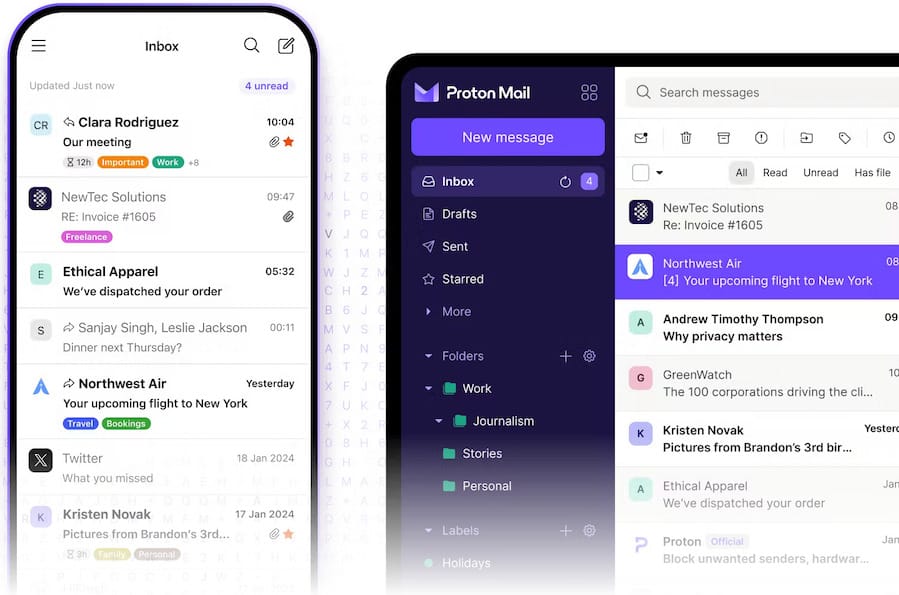
Sign in with your Proton account username and password. If you have two-factor authentication enabled (and you should), enter your TOTP code when prompted.
Step 3: Install Proton Mail via Snap (Alternative Method)
If you want automatic background updates and do not mind a slightly different package format, the Snap version is a legitimate option.
sudo snap install proton-mail
What this does: This single command downloads the Proton Mail Snap package from the Snap Store (maintained by Canonical), verifies its integrity, and installs it in an isolated container.
Why consider Snap: Snap packages update automatically in the background. You will always get the latest Proton Mail release without running apt upgrade manually. This is genuinely useful for users who do not actively maintain their system packages.
Where Snap falls short on Ubuntu 26.04: Snap-packaged Electron apps run inside a strict sandbox. On Ubuntu 26.04’s Wayland-only environment, some users have reported broken clipboard integration and inconsistent desktop notifications with the Snap version. The native .deb connects to the system clipboard and notification daemon directly, which is why it is the recommended method.
To launch the Snap version manually from a terminal:
snap run proton-mail
Or find it in the GNOME application menu like any other installed app.
Step 4: Configure Proton Mail on Ubuntu 26.04 with Proton Bridge (For Thunderbird Users)
This section covers a more advanced Proton Mail on Ubuntu 26.04 setup: using Proton Mail Bridge to connect your encrypted inbox to Thunderbird or Evolution. If you want to use Proton Mail only through the native desktop app, you can skip this section.
What Is Proton Mail Bridge and Why It Exists
Proton Mail uses zero-access encryption. Your emails are encrypted before they leave your device and can only be decrypted by you. Standard email clients like Thunderbird speak IMAP and SMTP, two protocols that assume plaintext communication. They have no built-in understanding of Proton’s encryption layer.
Proton Mail Bridge solves this by running as a local background service on your machine. It exposes a local IMAP server on port 1143 and a local SMTP server on port 1025, both bound to 127.0.0.1 (localhost only). Thunderbird connects to these local ports. Bridge handles all the encryption and decryption transparently.
Requirement: Proton Mail Bridge requires a paid Proton Mail subscription (Proton Mail Plus or higher). Free accounts cannot use Bridge.
Step 4.1: Download and Install Proton Mail Bridge
cd ~/Downloads
wget https://proton.me/download/bridge/protonmail-bridge_latest_amd64.deb
sudo apt install ./protonmail-bridge_latest_amd64.deb
The same apt install ./ approach applies here for the same reason: automatic dependency resolution.
Step 4.2: Run Bridge and Add Your Account
Launch Bridge from the application menu or from terminal:
protonmail-bridge --gui
Inside the Bridge interface, click Add Account, log in with your Proton credentials, and wait for the sync to complete. Bridge will generate a Bridge password, which is different from your regular Proton account password. Write this down or store it in your password manager. You will need it when configuring Thunderbird.
Why Bridge uses a separate password: Your actual Proton account password is what the encryption keys are derived from. Giving Thunderbird your real password would expose your master key to a third-party application. Bridge generates a local app-specific password that grants IMAP/SMTP access without exposing your encryption keys.
Step 4.3: Configure Bridge to Auto-Start as a systemd User Service
Without this step, you have to manually launch Bridge every time you log in before Thunderbird can connect. That gets old fast.
systemctl --user edit --force --full proton-bridge.service
This opens a blank service file in your default editor. Paste in the following configuration:
[Unit]
Description=Proton Mail Bridge
After=network.target

[Service]
Type=simple
ExecStart=/usr/bin/protonmail-bridge --noninteractive
Restart=always
RestartSec=10

[Install]
WantedBy=default.target
Save and close the file. Then enable and start the service:
systemctl --user enable --now proton-bridge.service
Why –noninteractive flag: Running Bridge in non-interactive mode tells it to operate as a pure background service with no GUI. This is exactly what you want for a headless daemon that starts at login. The Restart=always directive ensures it comes back up automatically if it crashes, and RestartSec=10 adds a 10-second delay before restart to avoid rapid-fire crash loops.
Step 4.4: Configure Thunderbird with Bridge Settings
Open Thunderbird and go to File > New > Existing Mail Account. Use these settings:
Incoming (IMAP):
| Field | Value |
|---|---|
| Server | 127.0.0.1 |
| Port | 1143 |
| Security | STARTTLS |
| Authentication | Normal Password |
| Username | your@proton.me |
Outgoing (SMTP):
| Field | Value |
|---|---|
| Server | 127.0.0.1 |
| Port | 1025 |
| Security | STARTTLS |
| Authentication | Normal Password |
| Username | your@proton.me |
Use the Bridge password (not your Proton account password) in the Password field for both.
Why localhost only: Bridge intentionally accepts connections only from 127.0.0.1. Your decrypted email never travels over the network during the IMAP/SMTP exchange. It stays on your local machine. This is the entire architectural point of Bridge — full encryption in transit to Proton’s servers, and decryption only on your own hardware.
Step 5: First Login, Account Setup, and Essential Settings
After launch, sign into your Proton account. If you have 2FA enabled, enter your TOTP code. Then go through these settings immediately after first login.
Enable Start on Login:
Go to Settings > General > Start on Login and toggle it on.
Why: Proton Mail stores your session token locally in the system keyring. If the app is not running, you will miss new mail notifications entirely. Starting on login ensures the session is active and the keyring is populated from the moment your desktop loads.
Enable Two-Factor Authentication if you have not already:
Log into account.proton.me in a browser, go to Security, and enable 2FA using an authenticator app like Aegis (open source) or any TOTP-compatible app.
Why 2FA is non-negotiable here: Your encrypted inbox is only as secure as the account protecting it. If your password is compromised (phishing, data breach on a reused password), 2FA is the last line of defense between an attacker and every email in your inbox.
Step 6: Verify the Installation and Check the Package Status
After installation, confirm that the package is properly registered on your system:
dpkg -l | grep -i proton
Expected output:
ii proton-mail 1.x.x amd64 Proton Mail desktop application
The ii at the start means: installed, configured, and working correctly. If you see iU or iF, the installation did not complete successfully and you should re-run sudo apt install ./ProtonMail-desktop-beta.deb.
To check the version specifically:
dpkg -l proton-mail
Troubleshooting Common Errors When You Configure Proton Mail on Ubuntu 26.04
Even with a clean install, a few issues come up regularly. Here are the ones you are most likely to hit and how to fix them.
Error 1: App Opens Then Closes Immediately
This is almost always a missing keyring dependency.
sudo apt install gnome-keyring libsecret-tools -y
Then reboot your session (log out and log back in, not just restart the app). Proton Mail stores your authentication token in the GNOME keyring. If the keyring daemon is not running when the app starts, the app has nowhere to save your credentials and exits silently.
Error 2: Desktop Notifications Do Not Appear
sudo apt install libnotify-bin notify-osd -y
On Ubuntu 26.04’s Wayland compositor, D-Bus notification support requires libnotify. Electron-based apps do not always list this as a hard dependency, so it can be absent on minimal installs.
Error 3: Bridge Cannot Connect After Thunderbird Setup
Open a terminal and check if the Bridge service is actually running:
systemctl --user status proton-bridge.service
If you see inactive (dead), start it manually:
systemctl --user start proton-bridge.service
Also confirm you are using the Bridge password, not your regular Proton account password, in Thunderbird’s account settings.
Error 4: SHA512 Checksum Returns FAILED
Delete the downloaded file immediately:
rm ~/Downloads/ProtonMail-desktop-beta.deb
Then re-download from proton.me and verify again. A failed checksum on a privacy app is a hard stop. Never install a package that fails checksum verification.
Error 5: How to Cleanly Uninstall Proton Mail
sudo apt remove proton-mail
sudo apt autoremove
Run autoremove after the removal. The first command removes Proton Mail, but orphaned dependency packages it originally pulled in remain on your system. autoremove identifies and cleans up packages that no other application depends on.
Security Practices After You Install Proton Mail on Ubuntu 26.04
Installing Proton Mail is step one. Keeping it secure is the ongoing responsibility.
Keep the package updated regularly:
sudo apt update && sudo apt upgrade -y
Proton Mail’s desktop app is built on Electron, which uses Chromium under the hood. Chromium security vulnerabilities are patched frequently. An unpatched Proton Mail client on a fully updated OS is still an attack surface.
Never run Proton Mail as root:
GUI applications launched as root have access to the root account’s keyring and session. Any exploit in the Electron renderer process would then have root-level access to your system. Always run as a normal user.
Audit your autostart entries periodically:
ls ~/.config/autostart/
Confirm only expected applications launch at login. This is standard Linux hygiene and takes ten seconds to check.
[su_box title=”VPS Manage Service Offer” style=”bubbles” box_color=”#000000″ radius=”10″]If you don’t have time to do all of this stuff, or if this is not your area of expertise, we offer a service to do “VPS Manage Service Offer”, starting from $10 (Paypal payment). Please contact us to get the best deal![/su_box]